Introduction
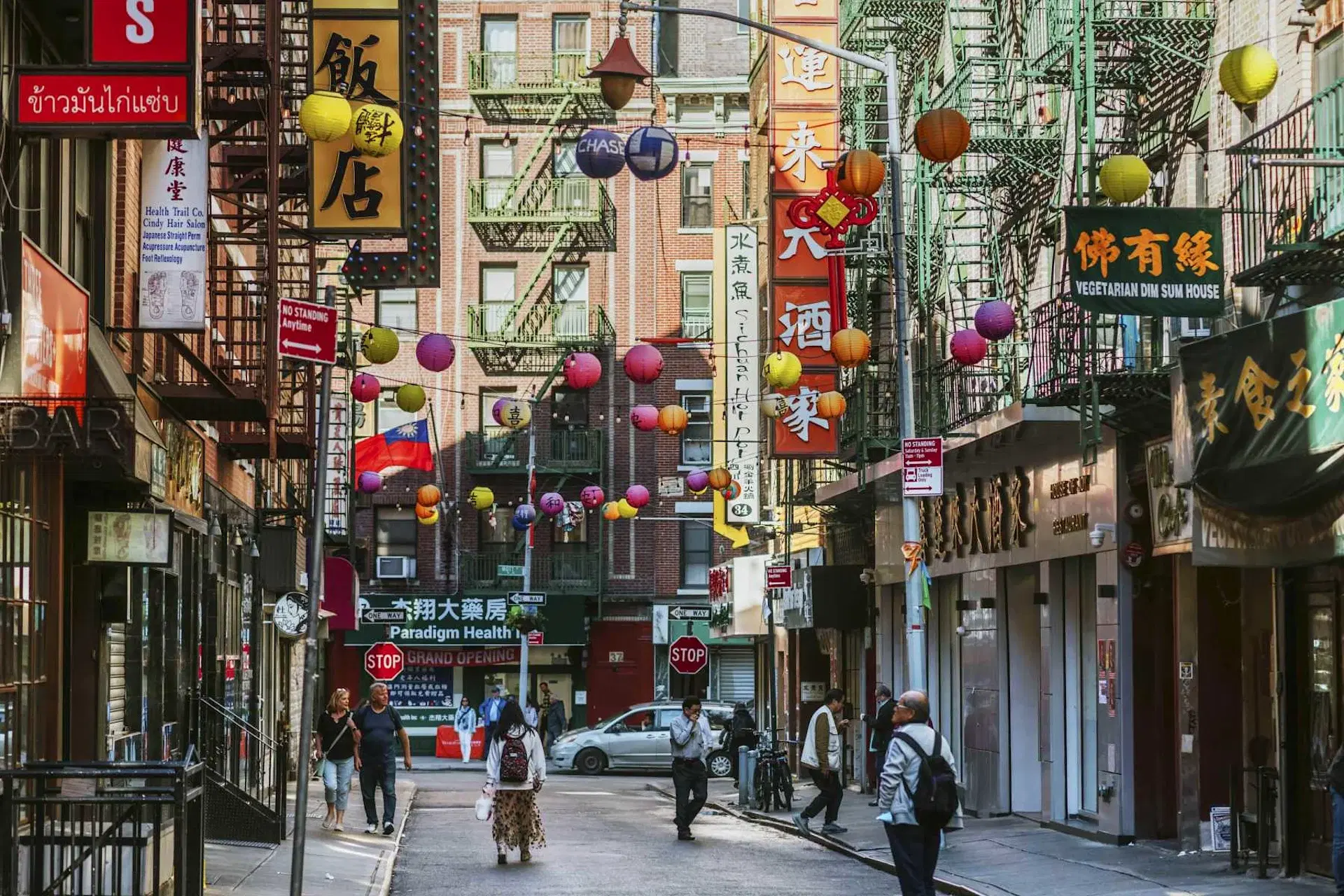
A blur of red and golden danced throughout the streets of Chinese Lunar New Year. The Chinese Dragon moves as one body, yet are held by a collective—symbolism of the values the community lives by. Red lanterns glow outside houses, mahjong tiles clatter by the elders table, and the scents of a New Year Feast flow out of the kitchen. To most people, Chinatown is a place with cheap food, milk tea cafes, and souvenir shops. However, Chinatown is more than just a community of family businesses; it's an ethnic economy built upon history, cultural preservation, legacy, and kinship. It's living proof of an alternative model of economic life: one sustained by belonging and identity rather than profit and individualism.
History of the Chinese Experience
The first wave of Chinese immigration began with gold, or rather the promise of it. Beginning in the late 1840s, the California Gold Rush saw thousands of Chinese people immigrate to the Gold Mountain, or what the Chinese called California. The population of Chinese immigrants jumped from around 7,500 in 1850 to more than 100,000 in 1880; 77% were living in California (MiraCosta College Library, 2025). After the gold rush hysteria died down, many Chinese immigrants found work in another rising industry: the railroad. In a project that connected the East coast to the West, the transcontinental railroad was constructed mainly by Chinese workers, with many estimating up to 80% of the workers to be Chinese (MiraCosta College Library, 2025).
Despite a history of hard work, Chinese immigrants faced discrimination and prejudice. The European population believed Chinese immigrants were taking too many jobs because of their willingness to work for lower wages. The 1871 anti-Chinese riot in Los Angeles saw more than twenty Chinese immigrants dead, with the term "yellow peril" originating to embody America's fear of Chinese people (PBS, n.d., para. 8). Political parties like the Deniz Kearney's Working Party rallied support for the destruction of Chinese business with slogans "The Chinese Must Go" (PBS, n.d., para. 8). The heightening racial tension culminated in the Chinese Exclusion Act of 1882, the first and only major federal law that prohibited immigration for one nationality. The act was renewed in 1892 and 1902, before finally being repealed in 1943 with the Magnuson Act, which allowed a mere 105 immigrants.
Even though Chinese immigrants faced everyday racism and laws that stripped them of their constitutional rights, many remained active in bettering their lives. For example, the judicial system was the primary method of challenging discriminatory laws, with 7,080 petitions filed challenging federal court decisions (O'Mahoney, 2022). With the help of Frederick Bee, a civil rights activist for Chinese immigrants and the Chinese Consul in San Francisco, many Chinese immigrants were able to secure reparation for previous property destruction from anti-Chinese riots. However, 2 court cases set back any progress achieved by litigation: Fong Yue Ting vs The United States of American (1893) ruled "that aliens reside in the United States under the absolute authority of Congress to expel them whenever it feels their removal is necessary", supporting decisions in the earlier Chae Chan Pin v. United States (1889) (Y. Wu, 2025). While United States v. Wong Kim Ark (1898) gave birthright citizenship to Chinese people, the earlier supreme court decision made Chinese immigrants extremely volatile in America; they could be removed without reason through deportation (Price, 2018).
Therefore, the most important factor for survival of Chinese immigrants remained Chinatown. Built upon family ties and district associations, they served as social and economic support systems. One of the first Chinatowns was built in Portsmouth Square, San Francisco (PBS, n.d.). Hundreds of Chinese immigrants set up family businesses, eventually branching out to Dupont and Kearny Streets. By 1880, the community had grown to over 22,000 people, filled with family run businesses like restaurants, retail shores, recreation centers, traditional herbal stores, market places, and even a theater dedicated to Chinese theatrical troupes. The diversity of family businesses built within the economic structures of historic Chinatowns allowed immigrants to survive the hostile environment. Specifically, by having marketplaces and restaurants for food, retail shores for clothing, herbal stores for medicine, and reaction centers like theaters for entertainment, there was no reason for many to interact with the outer city, where experiences of racism and violence were common. Additionally, the self-sufficient environment allowed resources to stay within the city, creating a circulating economy that generated resilience from outside pressure. San Francisco's Chinatown is a manifestation of economic security from racial oppression; Only until an earthquake in 1906 did the economy finally collapse (PBS, n.d.).
While the main purpose of Chinatown was to provide economic solidarity, it also served as a paramount tool for cultural preservation. New York City's Chinatown is the epitomization of the Chinese legacy. In 1890, the Mott and Pell streets were full of Chinese restaurants while Joss Houses (Taoist shrines) were an installation fixed into Chinatown (National Park Service, n.d.). Chinese actor Chu Fong famously opened an opera house, a Chinese language theater parallel to the one built in San Francisco. Similarly, Chinese architecture became prevalent throughout New York as immigrants modified existing buildings with Chinese ornaments and designs. For example, second story porches, pagoda-style porch roofs, and traditional ornaments became pervasive while bold plaques were ingrained into important buildings. One such building was the Chinese Consolidated Benevolent Association on 16 Mott Street, which became the consensus city hall of Chinatown (National Park Service, n.d.). Lastly, the Chinese community expressed their identity and preserved culture through funeral processions, New Years Eve celebrations, and political demonstrations, keeping traditions alive in the face of non-Chinese disparagement (Wilson, 2015).
Modern Chinatown
Chinatown isn't complacent, but rather constantly evolving to meet the needs of the new generation. In San Francisco, youth cultural workers have created new events like monthly night markets, cultural festivals mixing modern and traditional heritage themes, and curated stores to showcase Asian and Pacific Islander art (Z. Wu, 2025). However, it's not just the youth revolutionizing Chinatown. Vincent Pan, the executive director of Chinese for Affirmative Action, partnered with five nonprofits to form Chinatown Media & Arts Collaborative, opening an Asian American art gallery. Similarly, Philanthropist Florence Fang founded two museums dedicated to preserving Chinese American history. Beyond San Francisco, Chinatown's around America are rapidly changing. For example, Seattle's Chinatown has opened modern eateries with BBQ pork chops and hand-pulled noodles while Philadelphia's Chinatown has built new cafes and murals to fit the younger generation's vibe (Siegelman, 2025).
Amidst the changes Chinatown undergoes, the purpose of the community remains the same: find solidarity in the face of everyday struggles. Following the Trump administration's rhetoric surrounding the coronavirus in 2020–often using the phrase "Chinese Virus" and "Kung flu"–anti-Asian sentiment grew and hate crimes skyrocketed, hitting a peak in 2020 (Rejas, 2021, para. 2). The most common forms of discrimination were verbal harassment and shunning, but often hate grew violent. Out of the 2,808 reported incidents from March to December 2020, over 8% were physical assault (BBC News, 2021). One of the most tragic hate crimes was the death of six Asian women in Georgia, following a completely unprovoked shooting (Rejas, 2021). Asian businesses were vandalized, robbed, and destroyed, amplifying the financial pressure families faced.
Yet in the face of racism, Asian Americans fought back. One powerful example is San Francisco's Chinatown, where organizations formed to protect Asian Americans. Founded by Leanna Louie and Robert Lowe, the United Peace Front conducted safety patrols to protect elders, women and children (Robinson, 2022). In a similar fashion, Lily Ho founded the Delta Chinatown Initiative to organize rallies, hold townhalls, and build surveillance cameras to protect businesses and homes. Chinatown became more than a community. It became an ethnic enclave that brought solidarity, safety, and a sense of resilience in a time when Asians faced blatant discrimination and hate.
Beyond discrimination, Chinatown faces another looming problem: gentrification. Gentrification is a process in which the wealthy class move into a poor urban community, attracting new business and improving housing but displace the original community through rising costs. The case of Philadelphia's Chinatown demonstrates the struggles against gentrification powerfully. The city's Chinatown has faced gentrification since 1966, when the Vine Street Expressway attempted to destroy the Holy Redeemer Church and School, a "spiritual and educational core of the community" (Barber, 2025, para. 1). Now, they face threats from highway, prison, and corporate developments. Most recently, a $1.3 billion 76ers arena threatens to bring cultural erasure through an influx of fans, rising housing costs, and massive foot traffic (Barber). In the face of urban renewal projects, how did Philadelphia's Chinatown survive? The short answer: the community. Formed in 1966 to protect the Holy Redeemer Church and School, Philadelphia's Chinatown Development Corporation (PCDC) embodies the symbol of collective strength. The PCDC mobilized the city's community through coalitions, multilingual town hall meetings, flyers, and protests against unwanted urban projects, acting as a powerful community anchor in the face of unwanted urban sprawl (Barber, 2025). Gentrification is an everyday battle Chinatowns around America faces, but it's one Chinatown hasn't lost yet.
While Chinatowns have changed significantly since their original foundations, the structure remains the same. Chinatown today is still filled with family businesses, restaurants, recreation centers, marketplaces, and retail stores that allow communities to remain self-sufficient. In the place of closed down family businesses pop up new ones like boba cafes, souvenir shops, and restaurants blending Asian foods. Night markets, scavenger hunts, and lantern festivals are commonly held events to engage the community while intergenerational storytelling, ESL classes, youth sports programs, and Sunday Chinese school anchor the joy of teaching the youth. By circulating resources through family-run businesses and community owner centers while the elders guide the younger generation, Chinatown remains an enclave of both economic solidarity and lineage.
Likewise, Chinatown continues to be an anchor in cultural preservation. Streets are filled with parades, lit up by red lanterns, marched by residents, and enriched with the aroma of traditional foods during holidays like Lunar New Year and the Mid-Autumn Festival. Religious temples, cultural theaters, and recreational centers maintain popularity as new parks for elders are constructed. Even the architectural aesthetic remains the same; pagados have transformed into archways as bold plaques and Chinese ornaments continue to be a must (Maganga, 2021). The only difference? Traditions are combined with modern cultural shifts. Bold plaques are outlined with neon signs, cultural theaters have a twin movie theater beside them, and originally traditional restaurants now include a touch of American culture.
Conclusion
150 years later, the same blur of red and yellow dances through the streets of Chinese Lunar New Year. The same red lanterns glow outside houses, while mahjong titles clatter in crowded rooms beneath the hums of kitchens preparing holiday feasts. Beneath the boba cafes and delicious restaurants tourists see lies a legacy of determination, resilience, and community. Initially built out of necessity to combat discrimination, Chinatown has evolved beyond a community built for economic solidarity and cultural preservation. It has become a place where the old and new generation intertwine but values (belonging, identity, and community) remain constant. Chinatown's legacy isn't static. It grows and adapts under the same powerful values standing a century and a half later.